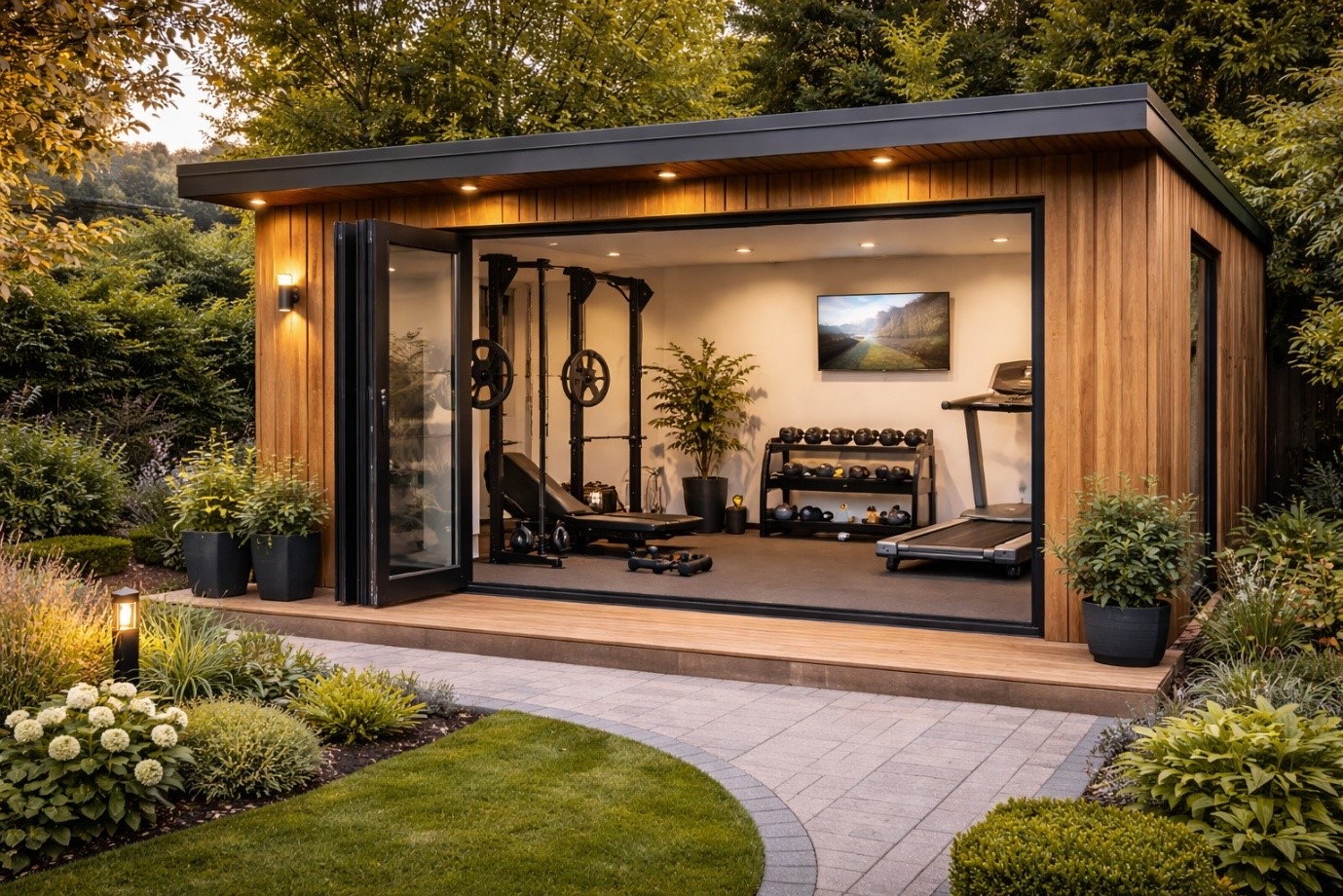
Placing your gym in a level, accessible spot close to the house makes workouts easy and convenient. For example, one guide notes that a home gym “by the garden door” saves you travel time and avoids crowded public gyms. Choose a flat site with good drainage so rainwater won’t pool under the gym; a solid foundation (like a concrete slab or raised deck) will keep the floor dry and stable. Aim for plenty of daylight in the space but also keep some privacy: consider fences, shrubs, or frosted windows so neighbors can’t see in easily.
- Level, near-house location: Easy to reach from home (saves commute) and simplifies running power and internet.
- Stable, well-prepared base: Ensure the ground is flat, firm, and drains well (pour a concrete slab or use adjustable pedestals).
- Light and privacy: Position windows or doors to let in sun, but add blinds or landscaping for seclusion.
Choosing to build garden gym spaces as part of a wider garden room project allows homeowners to tailor layouts, finishes, and features to their individual training needs. Providers such as Garden Rooms 365 demonstrate how purpose built structures can combine durability, comfort, and style to support year round use in all weather conditions.
Design the Gym Around How You Train.
Think about the exercises and machines you’ll use, and leave space to move safely. For example, if you have a squat rack or need room to stretch, make sure the building’s internal height is tall enough. In general, plan enough clearance around each piece of equipment to avoid hazards. Use shock-absorbing flooring (thick rubber mats or interlocking foam tiles) to protect your joints and spare the structural floor when you drop weights. A large mirror on one wall not only makes the room feel bigger, but also lets you check your exercise form. Store lighter items (like resistance bands or yoga mats) on racks or in cabinets so the floor stays open for workouts.
- Space for equipment: Lay out machines (treadmill, bench, rack, bike) with clearance on all sides. Higher ceilings (around 8 ft/2.4 m or more) are best for overhead lifting and jumps.
- Safe, cushioned floor: Cover the base with gym mats or rubber tiles to absorb impact. This protects your joints and prevents damage if weights fall.
- Mirrors and storage: Floor-to-ceiling mirrors help you work out safely. Wall hooks, shelves or a small cabinet keep accessories organized and the floor clutter-free.
Comfort and Insulation:
To use the gym year-round, insulate the walls, ceiling, and floor. As Bakers Garden Buildings explains, without insulation a garden room “would be far too cold” to use in winter. Fit double-glazed windows and a well-sealed door to keep heat in and noise out. In the winter, a space heater or a small heat pump can keep the room warm; in summer, fans or a reverse-cycle unit will cool it down. Make sure you can get fresh air too – include one or more openable windows or vents. Good ventilation prevents stuffiness and condensation when you sweat. In short, treat the gym like any living space: warm it in winter, cool it in summer, and seal it well.
- Thermal insulation: Line the walls and roof with proper insulation and install double-glazed windows. This keeps the gym warm in winter and more shaded in summer.
- Heating and cooling: Add a heater (or heat pump) for cold days and a fan or air conditioner for hot days. Some builders even fit a small HVAC or heat-recovery ventilation unit for fresh air.
- Ventilation: Plan for airflow. Windows or vents should open to let in fresh air and expel moisture. This keeps the space comfortable and prevents mold.
Power, Lighting, and Tech
Your garden gym will need electricity for lights and machines. Plan several wall outlets (or even floor-mounted outlets) where you need them. This lets you plug in treadmills, exercise bikes, TVs, and speakers without running cords across walkways. Install bright overhead lighting so you can train safely at any hour. For example, Waltons Garden Rooms suggests putting in overhead lights so “early mornings or late nights you can always workout”. Many people also add sound systems or a wall-mounted TV for workout videos and music. In short, treat it like a mini fitness studio: ample power points, clear lighting, and good Wi-Fi/speakers makes the room more enjoyable and functional.
- Electrical outlets: Include multiple sockets (even floor plugs) for cardio machines, chargers, or video screens. Plan these early to avoid extension cords.
- Good lighting: Use bright, diffused lights (and maybe skylights) so the gym feels open. Overhead LEDs or track lights are common. Ensure even light for safety.
- Entertainment/tech: Mount a screen or smart TV on the wall for online classes. Consider built-in speakers or a sound system. (Baker’s recommends floor sockets and mounted TVs for this purpose.)
Privacy and Focus:
A big perk of a garden gym is working out without an audience. Still, you can enhance privacy and limit distractions. Use frosted or tinted glass, blinds, or curtains on windows so people outside can’t see in, while still letting light enter. Good sound isolation helps too: a solid door and double-glazed windows will keep loud music or weight noises from traveling. For even quieter sessions, consider extra soundproofing (for example, acoustic insulation in the walls) to contain noise. In practice, most well-built garden rooms already dampen sound quite a bit. The result is a peaceful space where you can focus on your workout – and neighbors won’t hear every jump or drop.
- Window treatments: Add blinds or frost film to glass doors and windows for privacy. You’ll feel freer to change or lift weights.
- Sound control: Ensure the room is well-insulated and windows sealed. A solid, heavy door and acoustic seals will keep noise in. Soft flooring (mats or carpet) also reduces impact sounds.
- Eliminate distractions: Position the gym so you have a nice view of the garden or away from busy areas. Use the privacy to your advantage – this is your personal space to focus.
Long-Term Value and Benefits:
Beyond fitness, a garden gym adds value and flexibility to your home. Industry estimates suggest that a well-built garden room can raise your property’s value by 5–15%. It’s not just a workout space – it’s extra square footage. If you ever sell or repurpose the room, it could become an office, art studio, or relaxation space. In day-to-day life, it also becomes a useful multi-purpose room. Many owners note that with a gym at home they save on membership fees and don’t waste time commuting. It even becomes kid-friendly – you can keep an eye on children playing outside while you exercise, since you’re right at home. In short, investing in a garden gym often pays off through convenience, health, and a higher home resale value.
- Home value: A quality garden building can boost resale appeal – some surveys say it adds several thousand pounds to your home’s worth.
- Versatility: Down the road, the space can be repurposed (office, guest room, studio) if your needs change.
- Lifestyle benefits: You’ll save on gym memberships, enjoy the outdoors, and work out in comfort. As one guide notes, you can even stay fit while supervising kids or doing other chores – there’s no commute to eat into your day.
By planning carefully, you can turn a corner of your garden into a fully-equipped, year-round gym. Keep it simple and focused: choose a flat spot, insulate well, install good flooring, lighting and ventilation, and outfit it with the gear you’ll actually use. With these steps, your private garden gym will become a convenient, motivating space for exercise in any weather. The result is more than just an outdoor room – it’s a long-term investment in your health and home that pays off with every workout.
Don’t let your gym look like a shed, integrate it into your landscape using these Expert Tips for Gardens, Patios & Outdoor Living to ensure your fitness zone complements your patio’s style.