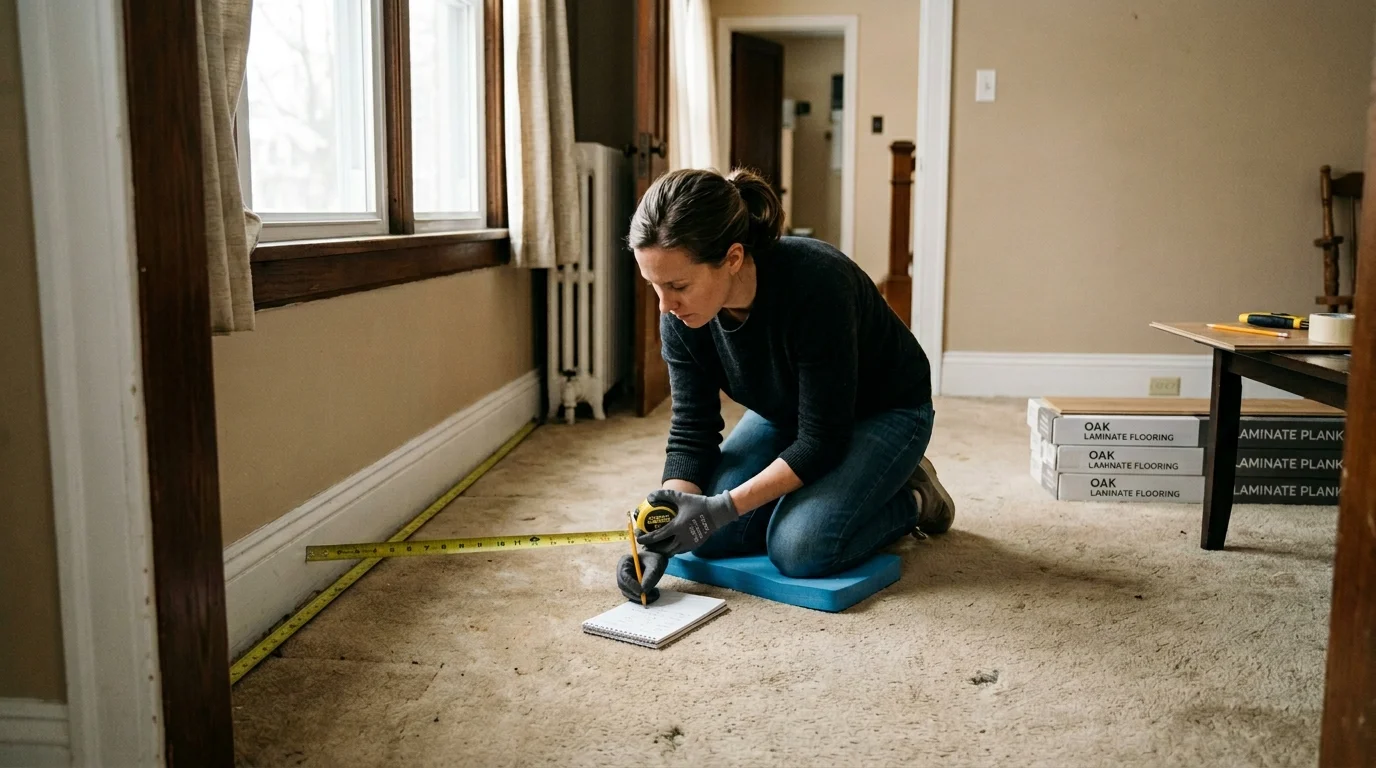
So you finally decided to put new floors down. Good. New floors make a huge difference in how a room feels. But before you go to the store or order anything online, you need to do one thing first, measure your room properly.
This sounds simple. It is simple. But a lot of people still get it wrong. They buy too little and have to stop the job halfway and run back to the store, only to find out the same batch is no longer available. Or they buy way too much and waste a few hundred dollars on planks they’ll never use.
I’ve seen both happen. More times than you’d think.
This guide is going to walk you through everything, from the tools you need to the math behind it, to every tricky room shape you might have. By the end of it, you’ll know exactly how to measure a room for flooring and how much flooring to buy, down to the last square foot.
What You’ll Need Before You Start
You don’t need fancy tools for this. Here’s what to grab:
A metal tape measure — at least 25 feet long. Don’t use a fabric one (like a tailor’s tape). Fabric stretches and gives you wrong numbers. A metal tape measure stays straight and gives you accurate results.
A pencil and paper — write everything down as you go. Don’t trust your memory. If you’re measuring multiple rooms, label each one.
A basic calculator — your phone calculator works fine.
A helper (optional but useful) — for long rooms, having someone hold the other end of the tape makes things faster and more accurate.
That’s it. You don’t need a laser measurer, you don’t need any app. Just a metal tape, a pencil, and a piece of paper.
The Basic Rule of Flooring Math
Before we get into room shapes, understand this one rule, and everything else gets easy:
Square Footage = Length × Width
That’s it. You measure two walls, multiply the numbers together, and you get the floor area. A room that’s 12 feet long and 10 feet wide has 120 square feet of floor space (12 × 10 = 120).
The numbers need to be in feet. If your measurement has inches in it — like 12 feet 6 inches — convert it to a decimal. 6 inches is half a foot, so 12 feet 6 inches becomes 12.5 feet. 3 inches is a quarter foot, so 12 feet 3 inches becomes 12.25 feet. Simple.
Need help with the math? Use our free Square Footage Calculator, just enter your measurements, and it does the rest for you.
Step 1 — Clear the Room First (Or at Least Move Furniture Away From Walls)
You don’t have to empty the entire room, but you need to be able to get your tape measure to the walls. If there’s a couch sitting against the wall, move it out a bit. You need to measure wall-to-wall, not couch-to-couch.
Also, one thing most guides skip: measure at the floor level, not at eye level. Walls can lean slightly, especially in older homes. A measurement taken at floor height gives you the most accurate number for what’s happening at floor level, which is exactly what matters here.
Step 2 — Measure the Length and Width
Stand inside the room. Measure the longest wall from one corner to the other. This is your length. Write it down.
Then measure the wall that runs perpendicular to it. This is your width. Write that down too.
One important thing: measure from wall to wall, not from baseboard to baseboard. Flooring goes under the baseboards (or at least right up to the wall behind them). If you measure only from baseboard to baseboard, you’ll end up short on material. Always go wall to wall.
Also, and this is where a lot of beginners make a mistake, measure at a few different points along the room, not just once. Rooms in older houses are often not perfectly square. One wall might be 12 feet at the top and 11 feet 10 inches at the bottom. If you only measured once, you might order short. Take two or three measurements along each wall and use the largest number.
Step 3 — Calculate Your Square Footage
Once you have your length and width in feet (with decimals if needed), just multiply them.
Let’s say your room is 14 feet long and 11 feet 6 inches wide. Convert 11 feet 6 inches to 11.5 feet. Then:
14 × 11.5 = 161 square feet
Write that number down. That’s your base floor area.
Step 4 — Add the Waste Factor (This Step Is Not Optional)
Here’s the step a lot of first-timers skip, and it causes real problems.
When flooring gets installed, pieces get cut to fit around edges, corners, doorways, and walls. Those cut pieces, the leftover small bits, mostly can’t be used again. That’s called waste. And you need to buy extra material to account for it.
The standard rule:
- Hardwood, laminate, LVP (luxury vinyl plank), engineered wood: add 10%
- Tile (straight pattern): add 10%
- Tile (diagonal or herringbone pattern): add 15% to 20%
- Carpet: add 10%, but there’s an extra thing to know here — I’ll cover that below
To add 10%, just multiply your square footage by 1.10.
So for our 161 square foot room: 161 × 1.10 = 177.1 square feet
Round up to 178. That’s what you order.
Why can’t you just buy exactly what you need? Because flooring runs out before the room is finished, usually on the last row. And if you go back to the store a week later, there’s a real chance they’ve sold out of that batch, or it came from a slightly different production run that doesn’t match your floor color exactly. You can never fully see the color difference until it’s installed. Then it’s a nightmare to fix.
Buy extra. Always.
How to Measure a Rectangular or Square Room
This is the easiest one. You already know how.
Measure the length. Measure the width. Multiply. Add 10%.
Done.
If your room is a perfect square — say 12 × 12 — it’s 144 square feet. Add 10% and you need 158.4, so order 159 square feet.
How to Measure an L-Shaped Room
L-shaped rooms are very common — think of a living room that wraps around a hallway, or a master bedroom with a sitting area off to the side.
The trick here is to split the L into two separate rectangles. Measure each one individually, calculate the area of each, then add them together.
Here’s how to do it:
Imagine your L-shape. Pick where you’d naturally “cut” it into two rectangles. It doesn’t matter exactly where you cut, both ways of dividing it will give you the same total area. Do whichever makes it easier to measure.
Rectangle A: Let’s say it’s 14 feet × 10 feet = 140 sq ft. Rectangle B: Let’s say it’s 8 feet × 6 feet = 48 sq ft
Total: 140 + 48 = 188 square feet
Add 10%: 188 × 1.10 = 206.8, so order 207 square feet.
The Square Footage Calculator on our site has an L-shaped room tab that handles this automatically — just punch in the four measurements and it adds them for you.
How to Measure an Irregular or Complex Room
Some rooms have bay windows, closets, alcoves, or just weird angles that don’t fit neatly into one rectangle. The same principle applies, break it down into rectangles.
Sketch the room out on paper first. Even a rough drawing helps a lot. Then divide it into as many rectangles as you need. Measure each one. Calculate the square footage of each one. Add them all together.
The more complicated the room, the more important it is to sketch it out first. It prevents you from forgetting a section.
One specific tip: if your room has a bay window that sticks out from the main wall, measure it as its own rectangle and add it in. Flooring goes into bay windows, too. Don’t leave it out.
Another tip: if there’s a large built-in cabinet or kitchen island that flooring will NOT go under, you can subtract that area from your total. Measure the footprint of the cabinet (length × width) and subtract it from the total room area. But, only do this if the cabinet is truly permanent and the flooring will never go under it. If there’s any chance it moves someday, don’t subtract it.
How to Measure for Carpet Specifically
Carpet is a little different from other flooring types, and a lot of guides don’t explain this properly.
Carpet comes in rolls. Standard carpet rolls are 12 feet wide. Some wider options come in 13 feet and 15 feet widths.
Why does this matter? Because when carpet is installed, the installer has to work with the width of the roll. If your room is 14 feet wide, you need two pieces of carpet — one full 12-foot-wide strip and one 2-foot-wide strip, and then they get seamed together. That seam costs extra material and extra labor.
For carpet, always note your room’s longest dimension AND widest dimension. The installer needs both to plan the direction the carpet runs and figure out how many pieces they need to cut from the roll.
If your room is 12 feet wide or less in one direction, you might be able to do it with one piece of carpet and no seam, which is cleaner and saves money.
Also, carpet is sometimes sold by the square yard, not square feet. To convert: divide your square footage by 9 to get square yards. A 200 square foot room = 22.2 square yards. Round up to 23.
Don’t Forget These Areas
This is where a lot of people short themselves on material:
Closets — if the closet has flooring going into it (not carpet, which often ends at the closet door), measure the closet separately and add it to your total. Even a small 3 × 5 foot closet is 15 extra square feet you might forget.
Under the door threshold — when you walk from one room to another, there’s usually a transition strip at the doorway. The flooring still runs up to that point. Make sure you’re measuring all the way to the wall, including that little section under the door frame opening.
Hallways connected to the room — if your room opens into a hallway with no door and the same flooring continues, measure the hallway too and add it to your total.
The Most Common Measuring Mistakes (And How to Avoid Them)
Measuring only once. Rooms are not always perfectly square, especially in houses built before the 1980s. Measure each wall twice at different spots and use the bigger number.
Measuring baseboard to baseboard instead of wall to wall. You’ll end up 2 to 4 inches short on each side. Doesn’t sound like much, but over a 200 square foot room, it adds up.
Forgetting to convert inches to feet. If your room is 13 feet 4 inches, that’s 13.33 feet, not 13 feet. If you just enter 13, you’ll be short.
Skipping the waste factor. I know I said it already, but it’s worth saying again. This is the single most common mistake. Always add at least 10%.
Not measuring closets and alcoves. These little areas add up. A 3-foot closet off a 12-foot bedroom is an extra 36 square feet if the closet is 12 feet deep, or less if shallower. Measure them, include them.
Trusting your memory. Write everything down right when you measure it. Your brain will mix up numbers, especially if you’re measuring multiple rooms in one session.
Waste Factor Quick Reference
Here’s a simple chart to use when shopping:
| Flooring Type | Waste to Add |
| Hardwood (straight install) | 10% |
| Hardwood (diagonal install) | 15% |
| Laminate | 10% |
| Luxury Vinyl Plank (LVP) | 10% |
| Engineered Wood | 10% |
| Ceramic or Porcelain Tile (straight) | 10% |
| Ceramic or Porcelain Tile (diagonal) | 15–20% |
| Herringbone or Chevron pattern | 15–20% |
| Carpet | 10% (plus extra for seams) |
For very simple rectangular rooms with no cuts, you might get away with 7%. For complex rooms with a lot of corners and angles, go with 15% just to be safe.
One Final Check Before You Order
Before you place your order, do this quick review:
- Did you measure wall to wall (not baseboard to baseboard)?
- Did you convert all inches to decimal feet?
- Did you include closets, alcoves, and bay windows?
- Did you use the largest measurement if the room walls aren’t parallel?
- Did you add the waste factor?
If all five boxes are checked, you’re ready to order.
Ready to Calculate? Use Our Free Tool
Now that you know how to measure, the easiest way to get your numbers is to use our free Square Footage Calculator. It handles rectangles, L-shaped rooms, triangles, and circles, converts between feet, inches, yards, and meters, and even gives you a flooring estimate with 10% waste already factored in.
Measure your room. Plug in the numbers. Get your answer in under 10 seconds. No math, no stress.
One more thing — if you have leftover flooring after the job is done, keep it. Store it flat in a dry place. If a plank gets scratched or a tile cracks two years from now, you’ll be glad you have a matching piece to swap in. Flooring products get discontinued all the time. The piece you saved could save you from a very expensive and annoying matching problem later.
That’s the full picture. Measure twice, add your waste, and buy once. That’s the whole job.