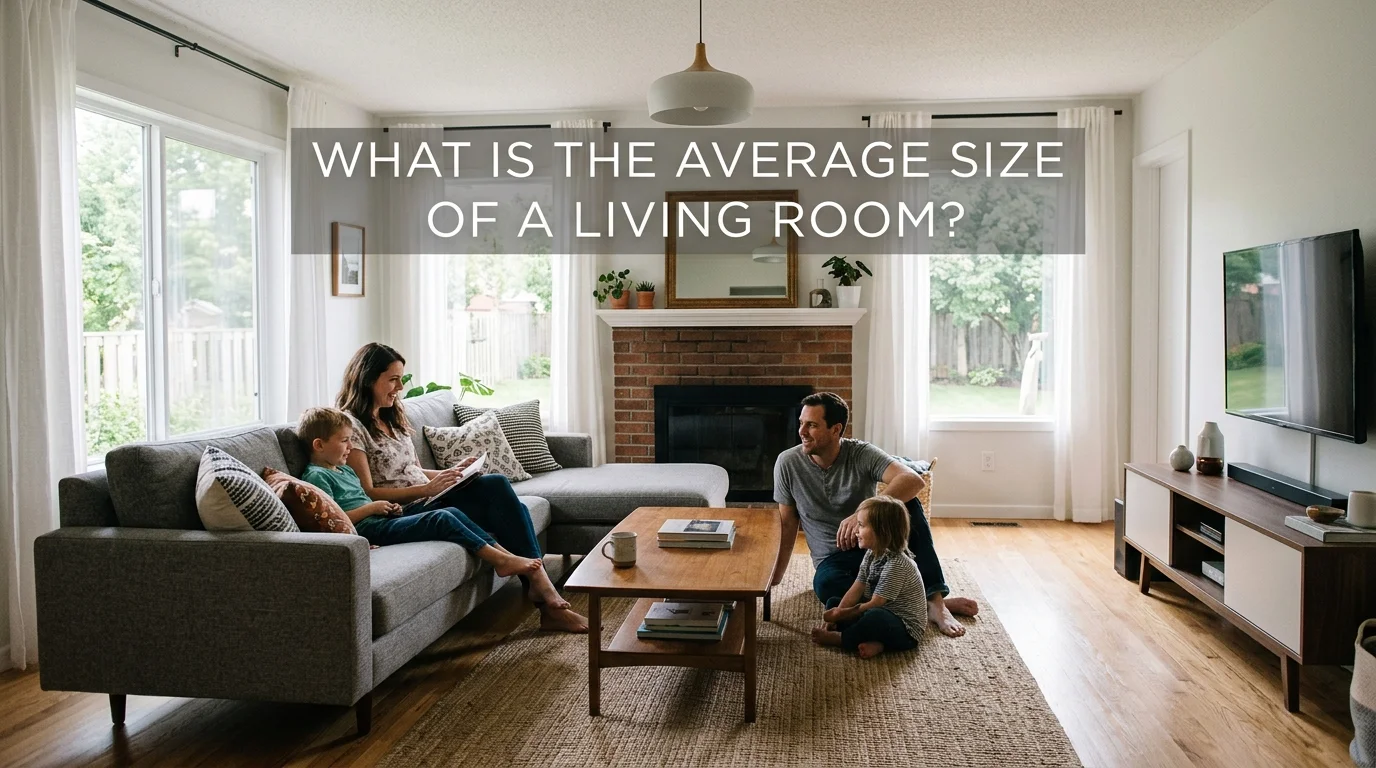
A lot of people don’t know how big their living room actually is until they need to buy flooring or a new sofa and suddenly realize they have no idea what the number is.
So let’s fix that.
The short answer is this — the average living room in the US is about 12 by 18 feet, which comes out to 216 square feet. Panel Town. That’s the most common size you’ll find in a typical American home. Not small, not huge, just right for most families.
But that number alone doesn’t really tell you much. A 12 × 18 room and a 10 × 12 room both exist in homes across the country, and they feel completely different to live in and cost completely different amounts to floor. So let me break this down in a way that actually helps you.
The Three Living Room Sizes — And What They Look Like in Real Life
Small Living Room — around 130 square feet
A small living room has typical dimensions of about 13 feet by 10 feet. Panel Town If you live in a city apartment, a condo, or a starter home, this is probably what you’re dealing with. It fits a small couch or a loveseat, a coffee table, maybe one chair. That’s about it.
It sounds tight, but small living rooms are actually easier to floor. You’re buying less material, the room is usually a simple rectangle, and there aren’t many awkward corners to deal with. A 130 square foot room with 10% waste added means you’re ordering about 143 square feet of flooring. Very manageable.
Medium Living Room — around 216 square feet
This is the sweet spot. The medium living room, the most common size in the US, averages 216 square feet with typical dimensions of 18 feet by 12 feet. Panel Town It fits two couches comfortably, a coffee table, a couple of chairs, and still leaves room to walk around without bumping into things.
Most of the living rooms I’ve seen in standard 3-bedroom homes fall into this range. It’s big enough to feel open but small enough that furnishing it doesn’t cost a fortune.
For flooring, 216 square feet with a 10% waste buffer means ordering about 238 square feet. At an average LVP price of around $3 per square foot, you’re looking at roughly $714 just in material. Knowing your actual square footage before you walk into a store makes a real difference at checkout.
Large Living Room — 300 square feet and above
A large living room has a footprint of 300 square feet or more, with common dimensions like 20 × 15 feet, 28 × 15 feet, or 30 × 18 feet. Panel Town These are usually found in bigger suburban homes, open-plan layouts, or homes built in the last 20 years.
Large living rooms feel great but they cost noticeably more to floor. A 300 square foot room with waste added becomes 330 square feet to order. If you’ve got an open-plan setup where the living room flows into the dining area with no wall in between, you’re probably dealing with 400 to 500 square feet of flooring all in one go.
Why Living Room Sizes Have Changed Over the Years
Here’s something interesting. Living rooms today are significantly larger than they were 50 years ago. The average living room dimensions have increased by over 91% compared to the 20th century. Woodenfloorsuk Homes built in the 1950s and 60s had much smaller common areas — people used their living rooms differently back then, mostly for formal occasions, not everyday family hangout space.
Today, the living room is where everything happens — TV, homework, guests, kids playing, working from home. So builders started making them bigger. If you’re in an older home, don’t be surprised if your living room is on the smaller side even for the same number of bedrooms as a newer house.
City vs. Suburbs — The Size Gap Is Real
Where you live matters more than you might think when it comes to living room size.
Urban apartments usually feature smaller living rooms averaging 150 to 250 square feet, while suburban homes trend larger, with many new constructions offering 300 to 500 square feet of living space.
So if you’re in a city apartment and your living room feels small, it probably is, and that’s completely normal. If you’re in the suburbs and your living room still feels tight at 220 square feet, it might be the furniture layout, not the room itself.
The 10% Rule for Living Room Size vs. Your Whole Home
Here’s a simple rule that builders and architects often use: a general rule of thumb is that the living room should be at least 7.5% of the total square footage of the house for large homes, and about 11% for smaller homes.
What does that mean in practical terms?
- 1,200 sq ft home → living room should be roughly 130–140 sq ft
- 1,800 sq ft home → living room should be roughly 135–200 sq ft
- 2,500 sq ft home → living room should be roughly 190–275 sq ft
If your living room is way below these numbers, the room probably feels cramped even if you can’t put your finger on why.
What This All Means When You’re Buying Flooring
Here’s where this gets useful in a practical sense.
Most people guess at how much flooring to buy. They walk into the store, say “my living room is like, medium sized I think,” and then either buy too little and run out mid-job, or buy way too much and spend money they didn’t need to spend.
Don’t guess. Measure the room, then calculate.
A quick reference for what to order based on room size:
| Room Size | Square Footage | Order This Much (with 10% waste) |
| 10 × 12 ft | 120 sq ft | ~132 sq ft |
| 12 × 15 ft | 180 sq ft | ~198 sq ft |
| 12 × 18 ft | 216 sq ft | ~238 sq ft |
| 15 × 20 ft | 300 sq ft | ~330 sq ft |
| 20 × 20 ft | 400 sq ft | ~440 sq ft |
If your living room is L-shaped — which is common in open-plan homes where the space wraps around — you’ll need to split it into two rectangles, measure each one, and add them together.
Our free Square Footage Calculator does all of this for you. It has a specific L-shaped room mode, converts between feet, inches, and meters, and gives you the flooring estimate with the 10% waste already added. Takes about 30 seconds to use.
One Thing Worth Knowing Before You Measure
Most living rooms that look rectangular are not perfectly rectangular. Older homes especially have walls that are slightly off-square — one side might be 18 feet and the opposite wall 17 feet 9 inches. Not a huge difference, but if you measure only one wall and order based on that, you might come up a little short.
Always measure both pairs of opposite walls. Use the bigger number each time. It costs you almost nothing extra in material but saves you a real headache during installation.
The average living room is about 12 × 18 feet, or 216 square feet. Small ones sit around 130 square feet. Large ones go 300 square feet and beyond. Where you live, when your home was built, and how your floor plan is laid out all affect where your room falls on that scale.
The only way to know for sure is to measure it yourself. It takes five minutes. And once you have the number, buying the right amount of flooring becomes completely straightforward.
Measure your room → plug the numbers into our Square Footage Calculator → get your exact flooring order in seconds.