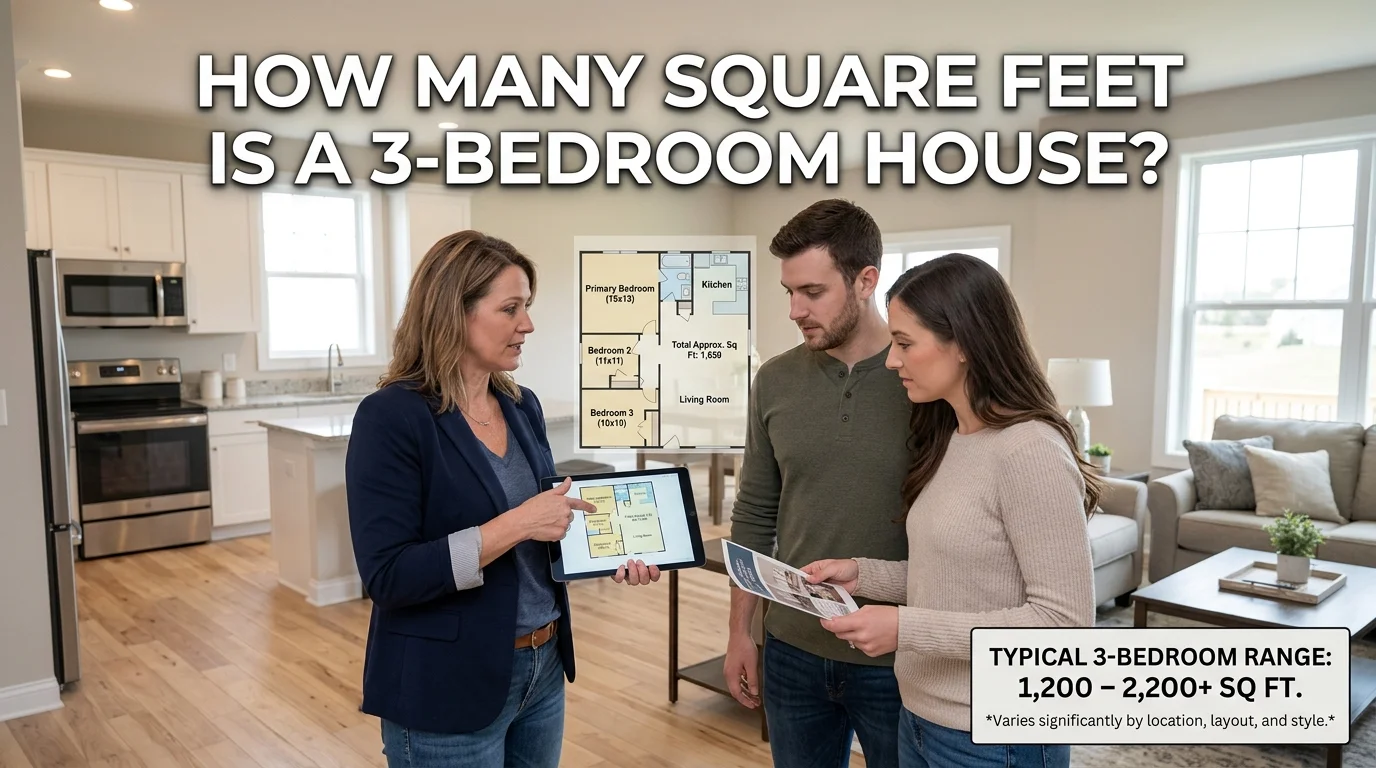
Between 1,200 and 2,000 square feet. That is the typical range for a 3 bedroom house in the United States.
Now the number most people actually end up with, specially in suburban areas, is somewhere around 1,500 to 1,800 square feet. US Census Bureau data says the median size of a completed single family home in 2026 was 2,146 square feet. But that number covers all bedroom counts together. A 3 bedroom home alone usually sits below that.
Already know your room sizes? Just put them in our Square Footage Calculator and get your number fast.
Why Is the Range So Big?
People notice this right away. 1,200 square feet and 2,000 square feet, these are not even close to the same home.
So why no single number?
Because location changes everything. A 3 bedroom house in Manhattan is nothing like a 3 bedroom house in suburban Texas. A house from 1962 and a house from 2022, both with 3 bedrooms, can be 600 square feet apart easily.
Here is the simple breakdown.
1,000 to 1,400 square feet (Small)
Older city neighborhoods mostly. Starter homes, houses from the 1950s and 1960s. Three bedrooms exist but none of them are big. Maybe one bathroom, maybe two small ones. Kitchen and living room feel tight. Families lived in these homes fine. Expectations were just different back then.
1,400 to 1,800 square feet (Average)
This is what most people call a normal house in America right now. Suburban homes from the 80s and 90s mostly fall here. Two proper bathrooms. A kitchen with working space. Living room where you can actually sit comfortably. A family of three or four fits here without problems.
1,800 to 2,200 square feet (Large)
Newer construction goes here a lot. Master bedroom starts feeling like a real suite. Kitchen gets an island. Walk in closet that actually fits clothes. You notice the difference when you walk in.
2,200 square feet and above (Very Large)
For only three bedrooms this is generous. Extra space goes into a big master suite, formal dining room, bonus room, or home office. Some people love it. Others find they heat and clean rooms they barely enter.
How Home Sizes Changed Over Time
In 1973 the average American home was around 1,660 square feet. A 3 bedroom house at 1,200 square feet was completely normal. Nobody felt shortchanged.
Then homes started growing. By 2015 the average new home peaked at around 2,467 square feet. Bigger bedrooms. Open kitchens. Two car garages as standard. Americans wanted more space and builders gave it.
After 2015 something changed. Sizes started coming back down. Building costs went up. Land got expensive. Affordability became a real problem. By 2026 the median new single family home was about 2,210 square feet, down from that 2015 peak.
So if your newer 3 bedroom home feels smaller than what you expected, that is not your imagination. That is just the market now.
Square Footage by Region
Where you live matters more than people think.
These numbers are for new construction only. And for all bedroom counts, not just 3 bedroom homes.
Buying an older existing home? Expect the actual size to be 20 to 30 percent smaller than these figures, depending on when it was built.
How the Space Actually Breaks Down Inside
Knowing the total is useful. Knowing where it all goes is more useful.
Master bedroom: 200 to 300 sq ft
Biggest bedroom in the house. Newer homes attach a bathroom and walk in closet to it which pushes the number higher. In older homes the master was sometimes the same size as every other bedroom. Nobody thought that was strange back then.
Bedrooms 2 and 3: 100 to 150 sq ft each
A 10 by 10 room is 100 sq ft. A 10 by 12 room is 120 sq ft. Enough for a bed, a dresser, a small desk. Millions of kids grew up in rooms this size and turned out fine.
Living room: 200 to 300 sq ft
In a smaller home that is a 12 by 15 space. In a bigger home you get something closer to 15 by 20. Open layouts connecting the living area to the kitchen make even small numbers feel bigger than they are.
Kitchen: 100 to 175 sq ft
A 10 by 10 kitchen is tight but it works if designed properly. A 12 by 14 kitchen is where people start feeling comfortable. Newer homes pushed kitchens bigger because buyers kept asking for it.
Bathrooms: 50 to 100 sq ft each
A full bathroom with tub, toilet, and vanity runs around 50 to 80 sq ft. A master bath with double vanity and separate shower can hit 100 or more.
Hallways, closets, laundry: 100 to 200 sq ft total
Nobody thinks about this on a home tour. But it adds up. Hallways, linen closet, coat closet, laundry room. None of it feels like living space. All of it shows up in the total number on the listing.
What Does Not Count as Square Footage
This surprises many buyers.
The number on a listing only counts finished, heated, livable space. A lot gets left out even if you use it every single day.
Unfinished basement: Could be 1,000 square feet that your whole family uses for storage. Counts as zero until properly finished with real walls, flooring, and heat.
Garage: Two car garage adds 400 to 600 square feet to the building. Does not count as living space at all.
Porches and decks: Outdoor areas do not count, even covered and fully furnished ones.
Unfinished attic: No proper staircase, no proper finish, it does not count.
Two homes with the exact same listed square footage can feel totally different because of this. The one with a finished basement feels like a completely different house.
How Square Footage Affects Your Flooring Budget
This is where the number becomes very practical.
Flooring is sold by the square foot. Replacing floors in a 1,600 sq ft home means you are not buying 1,600 sq ft of material. You need extra for waste. Pieces cut at edges and doorways mostly cannot be used again.
Standard rule is add 10 percent. So 1,600 sq ft becomes 1,760 sq ft to order.
At $3 to $8 per square foot for materials, depending on laminate, LVP, hardwood, or tile, a full house flooring project runs $5,000 to $14,000 in materials alone. Labor is on top.
Buy too little and you stop mid job. Go back to the store and that same batch might be sold out already.
Our Square Footage Calculator lets you enter each room separately with the waste factor already built in. Want to measure each room properly before you start? Read our guide on how to measure a room for flooring first.
Is a 1,500 Square Foot 3 Bedroom House Enough?
First time buyers ask this constantly when budget is tight.
Here is a simple way to think about it.
1,200 sq ft: Fine for two people. Gets tight with a third. Manageable for a small family if everyone is okay being close.
1,500 sq ft: Comfortable for a couple with one or two kids. Things fit. Not a lot of extra room but it does not feel cramped either.
1,800 sq ft: Good for a family of four. Everyone has their own bedroom. Common areas feel open. Most people stop wanting more at this size.
2,200 sq ft and above: Plenty of room for four or five people. Space for a home office, guest room, hobby room. You appreciate it when everyone is home at once.
One thing worth knowing. A well designed 1,500 sq ft home often feels bigger than a poorly designed 2,000 sq ft one. High ceilings, open layout, good light and smart storage change how a home feels far more than the raw number does.
Quick Reference Chart
Final Thought
1,400 to 1,800 square feet. That is where most 3 bedroom homes in the US land right now.
Older homes run smaller. Newer builds go bigger. Location changes everything.
Planning new floors, fresh paint, or any renovation? Knowing your actual square footage saves real money. Use our Square Footage Calculator and get your answer room by room in under a minute.
And if you have leftover flooring after a project, keep it. Store it flat somewhere dry. Flooring gets discontinued constantly and a matching piece two years later when something gets scratched is worth more than the closet space it takes up.